

AI Agents for Business: What They Do, How They Differ From a Chatbot
An AI agent does not only answer, it acts inside your systems. What separates it from a chatbot, why Hebrew breaks half the off-the-shelf products, and when an agent simply does not pay back.
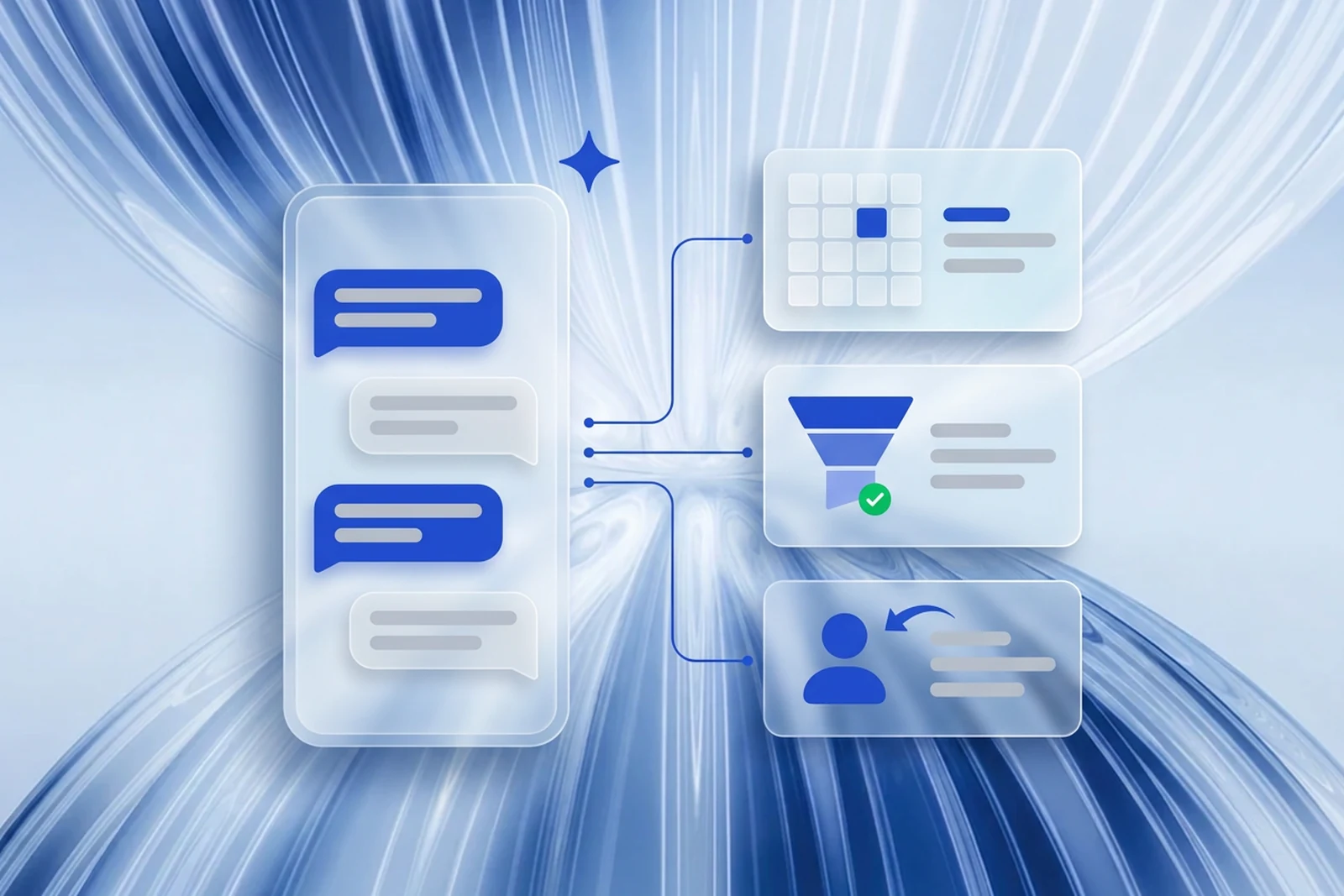

TL;DR: An AI agent is not an improved chatbot. A chatbot routes a question to a prepared answer; an AI agent understands an open question, retrieves an answer from your own knowledge sources, and carries out an action in the systems you already run - opening a lead, booking a meeting, checking an order. The practical difference is that an agent finishes tasks while a bot only passes them on. That difference is also what makes it more expensive to build, because any action that changes data needs permissions, an audit trail and a way to undo it.
Most businesses that approach us about AI agents have seen an impressive demo and want one. The trouble is that a demo always works: it was built around questions the presenter chose. What decides whether an agent survives contact with real customers is exactly what a demo never shows - what happens when it does not know, what happens when the customer writes in broken Hebrew, and what happens when it gets a price wrong. This article is about that.
What is the difference between a chatbot and an AI agent?
| Aspect | Classic chatbot | AI agent |
|---|---|---|
| How it understands | Menu or keywords | An open question in natural language |
| Source of the answer | A script written in advance | Your own knowledge sources |
| What it does | Routes, points at a form | Carries out an action in a system |
| When there is no answer | Gets stuck or returns to the menu | Says it does not know and hands over |
| Build cost | Low | Higher, driven by the number of actions |
The third row is the one that matters. The moment an agent performs an action - opening a record, booking a meeting, updating a status - it stops being an interface and becomes a user of your systems. That is where the value comes from, and it is also where the risk comes from.
What an AI agent actually does in a business
- First response around the clock. Questions about price, availability, opening hours and order status get answered the moment the enquiry lands. Most WhatsApp enquiries arrive after working hours, which is exactly when the customer is also checking your competitor.
- Lead qualification. The agent asks the qualifying questions you defined - type of business, scope, timeline - so what reaches you is a lead with answers attached rather than a name and a number.
- Meeting booking. Checking calendar availability, booking the slot and sending the reminder, without anyone re-keying details at the end of the day.
- Answers from your content. Pricing, service terms and catalogue are loaded as the knowledge base; update a document and the answers move with it.
- An orderly handover to a person. When the subject crosses the boundary you set, the conversation moves to a human with the full transcript.
The real problem: hallucination, and why it costs money
A language model is built to produce an answer even when it has no source. That is not a fault, it is how it works, and in a business setting it is the central risk. A price the agent invented is a statement made in your name, and a customer who has it in writing will expect to receive it.
The fix is not asking the model politely not to invent. It is constraining it: the agent answers from your sources only, and when a question has no source the defined behaviour is to say so and pass the conversation to a person. Before launch it is worth running a set of deliberately awkward questions to find where it gives way. The gap between a wrong answer and a missing one is the gap between a complaint and a follow-up call.
Hebrew: why half the off-the-shelf products break here
Hebrew is where demos stop working. Hebrew text arrives with mixed full and defective spelling, heavy abbreviation, product names in Latin script mid-sentence, and RTL directionality that changes how replies render in WhatsApp and on the site. An agent built in English and translated afterwards answers a well-formed question correctly and breaks on how an Israeli customer actually writes.
The right test is not a list of sample questions but your own real enquiries from recent months. That is also the stage where it often emerges that the price list itself is written in a way nobody can answer from - which is a problem with the business, not with the model.
When an AI agent does not pay back
Plainly: it is not for every business. At five enquiries a week an agent will not recover its build and running cost, and the same budget is better spent on campaigns or organic search that generate enquiries in the first place. An agent pays back when there is recurring volume, when a large share of the questions repeat, and when response time genuinely affects whether you win the work - for instance where a customer contacts three suppliers and goes with whoever answered first.
A simple test: if you answer the same question more than ten times a week, there is something here worth automating.
How to start properly
Start from the conversations already happening, not from the model. Read the enquiries of recent months, mark what repeats, and agree in writing what the agent takes and what stays with a person. Then connect to the systems with a narrow permission for each action, and run a pilot on part of the traffic - read real transcripts and correct before widening.
That stage looks like a delay, and it is what stops the agent meeting every one of your customers with the same mistake. The full service is described on our AI agent development page, and if you want to check which of your enquiries are even suitable for automation, talk to us.